Construction cash flow forecasting, with a free 13-week template
Last checked 4 October 2026
Why money runs short on jobs that make a profit, how to forecast the next 13 weeks, and a free Excel look-ahead that does the sums and flags the tight weeks.
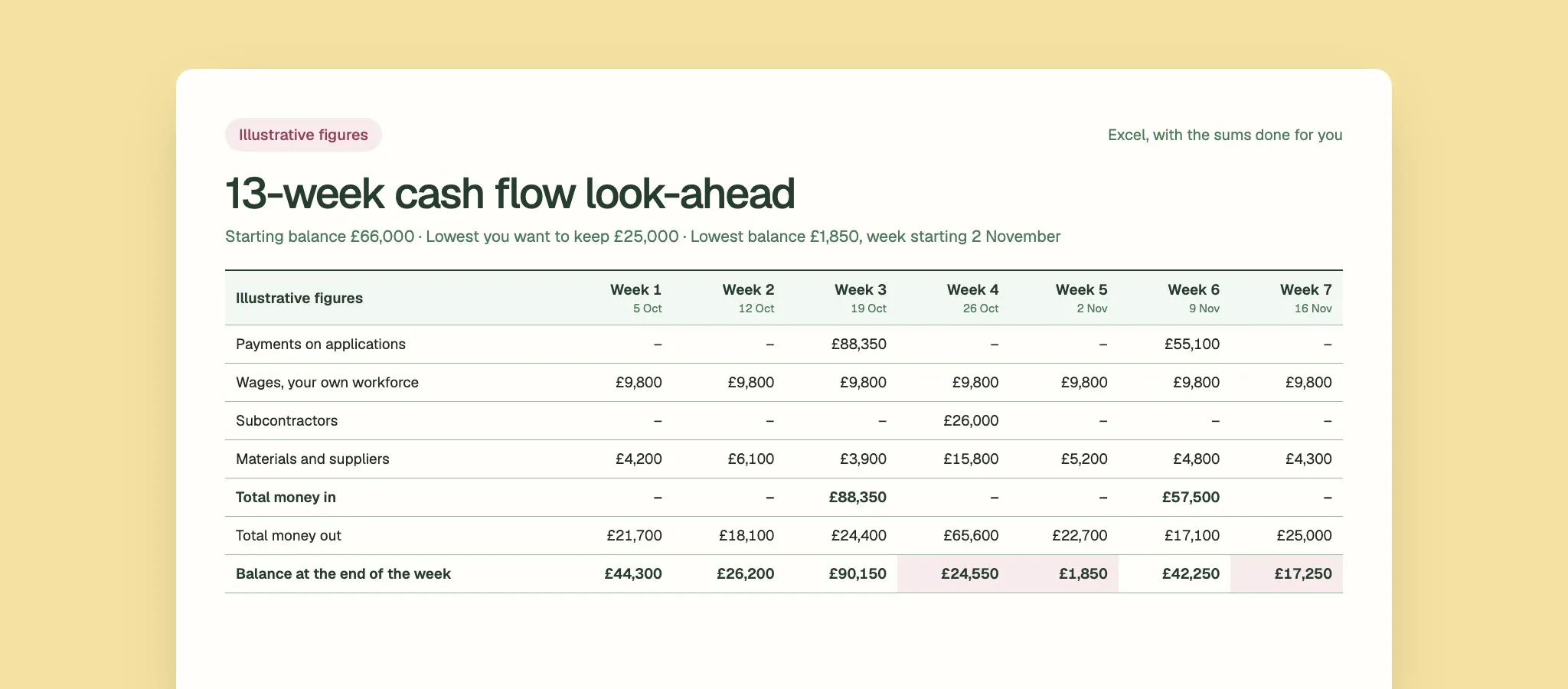
A job can make money and still leave you short in the bank, because wages and suppliers are paid weeks before the client pays you. A 13-week look-ahead shows the gap before you reach it, while you can still chase a payment, move a supplier run or talk to the bank.
What is cash flow in construction?
Cash flow in construction is the timing of money in and out of your bank: applications and valuations paid by clients coming in, and wages, subcontractors, suppliers, plant and tax going out. Contractors are generally paid in arrears, so money for this month's work often arrives weeks after you've paid for it.
Profit and cash answer different questions. Profit tells you whether a job makes money by the end. Cash flow tells you whether you can pay everyone on Friday.
Why do construction firms run short of cash?
Mostly because of timing. You pay your own people every week and your suppliers every month, while each application waits for a valuation, a payment notice and the final date for payment. Retention holds back part of every payment until completion and beyond, and a pay less notice can cut what arrives.
- 1
You're paid in arrears
You pay for labour, materials and plant first, and the client pays for that work later. Until each application is paid, your business is funding the job.
- 2
Payment terms stretch the wait
Each payment has a due date and a final date for payment. Where a contract sets neither, the Scheme's defaults put the final date 24 days after the valuation period ends.
- 3
Retention holds money back
The government's 2017 consultation described retention as typically 5% of each payment, with half released at completion and half after a defects period of usually 12 to 24 months.
Source: GOV.UK, Retention payments in the construction industry (2017)
- 4
Valuations come in lower
If the payer gives a valid pay less notice in time, it only has to pay the sum in that notice. Track the dates on every application so you know what to expect, and when.
Source: Construction Act, section 111
When an application gets paid if your contract is silent
Day0
Valuation period ends
Your application is in.
Day7
Payment due
Seven days after the period ends.
Day12
Payment notice
The latest the payer can say what it will pay.
Day17
Last day to pay less
A pay less notice after this is too late.
Day24
Final date for payment
The money should be with you.
Retention may change. The Commercial Payments Bill, which was before Parliament on 4 October 2026, would ban retention deductions in construction contracts, and the government says it will consult on when that starts. Until a change is law and in force, the retention terms in your contract still apply.
What does the Construction Act say about getting paid?
The Housing Grants, Construction and Regeneration Act 1996 gives you the right to stage payments on jobs of 45 days or more, a due date and final date for each payment, and a notice of what will be paid. Pay-when-paid clauses don't work, and you can suspend work or go to adjudication if you're not paid.
| Right | What it means | Where it's set |
|---|---|---|
| Stage payments | You can be paid in instalments, unless the work is agreed to last less than 45 days. | Section 109 |
| Payment notice | The payer says what it will pay, and how it worked it out, within 5 days of the due date. | Section 110A |
| Pay less notice | To pay less than the notified sum, the payer must give notice before the final date. If the contract sets no period, the notice is due 7 days before it. | Section 111; Scheme, para 10 |
| Pay-when-paid | A clause making your payment depend on the payer being paid by someone else doesn't work, unless someone up the chain is insolvent. | Section 113 |
| Suspending work | If you're not paid by the final date, you can suspend work after giving at least 7 days' notice, and claim reasonable costs. | Section 112 |
| Adjudication | You can refer a dispute to adjudication at any time. The adjudicator decides within 28 days of the referral, unless that's extended. | Section 108 |
These rules apply in England, Wales and Scotland. They don't cover work for a homeowner on the home they live in. If a business customer pays late, you can usually claim interest at 8% above the Bank of England base rate, unless your contract sets its own rate.
How do you prepare a construction cash flow forecast?
Start with today's bank balance, then list every payment you expect in and out over the next 13 weeks, in the week the money actually moves. Work out when each application will really be paid from its contract terms, add up each week, and look for the weeks where the balance drops below the level you're comfortable with.
Some people call it a cash flow projection. It's the same thing, and it takes seven steps:
- 1
Start from today's bank balance.
Use the real figure, not the one in last month's accounts.
- 2
List what you've applied for, and when each will be paid.
Work from each contract's due date and final date, less retention and anything likely to be cut.
- 3
Add the weekly costs.
Wages, plant hire and anything else that goes out every week.
- 4
Add the monthly and quarterly ones.
Subcontractors, suppliers, salaries, PAYE and CIS, VAT, rent and loan repayments, each in the week it leaves the bank.
- 5
Set the lowest balance you want to keep.
Then look for the weeks that drop below it.
- 6
Deal with a tight week now.
Chase an overdue application, move a supplier run or talk to the bank before the week arrives.
- 7
Update it every Monday.
Roll it on a week and compare what happened with what you expected.
A free 13-week cash flow template
The Excel look-ahead follows those steps and does the sums. Put each application on the Receipts tab and it works out the week the money should arrive. It then adds up every week and flags any that fall below your minimum. There's a PDF to fill in by hand as well.
13-week cash flow look-ahead
Starting balance £66,000. The dotted line is the lowest you want to keep, £25,000.
Illustrative figures
| Week | Money in | Money out | Balance at the end of the week |
|---|---|---|---|
| Week 15 Oct | – | £21,700 | £44,300 |
| Week 212 Oct | – | £18,100 | £26,200 |
| Week 319 Oct | £88,350 | £24,400 | £90,150 |
| Week 426 Oct | – | £65,600 | £24,550 (below your minimum) |
| Week 52 Nov | – | £22,700 | £1,850 (below your minimum) |
| Week 69 Nov | £57,500 | £17,100 | £42,250 |
| Week 716 Nov | – | £25,000 | £17,250 (below your minimum) |
| Week 823 Nov | £111,150 | £72,400 | £56,000 |
| Week 930 Nov | £14,800 | £22,000 | £48,800 |
| Week 107 Dec | £53,200 | £31,500 | £70,500 |
| Week 1114 Dec | – | £15,950 | £54,550 |
| Week 1221 Dec | £106,400 | £76,700 | £84,250 |
| Week 1328 Dec | – | £18,800 | £65,450 |
Three weeks dip below the minimum. The tightest is week 5, at £1,850: the month-end payments go out in week 4, and Project B's application isn't paid until week 6. Seeing that in October gives you time to chase the payment, move a supplier run or talk to the bank.
Free to use and change. Two example tabs show it filled in with illustrative figures.
The sheet has a line for each of these, so nothing regular gets missed:
Money in
- Payments on applications
- Retention released
- Other money in
Money out
- Wages, your own workforce
- Subcontractors
- Materials and suppliers
- Plant and equipment hire
- Office salaries
- PAYE, NI and CIS to HMRC
- VAT to HMRC
- Rent, insurance and overheads
- Loan and finance repayments
- Other money out
What is CVR in construction?
CVR, or cost value reconciliation, compares the value of the work you've done on a job with what it has cost you, both taken to the same date, usually month-end. RICS calls it the project's profit and loss statement. In its simplest form, it tells you whether a contract is making or losing money right now.
| CVR | Cash flow forecast | |
|---|---|---|
| The question | Is this job making money? | Will there be enough in the bank each week? |
| What it compares | The value of work done with the cost to date, including costs not yet paid | Money actually coming in with money going out |
| How often | Monthly, with cost and value cut off on the same date | Weekly, rolled on each Monday |
A job can show a healthy margin in the CVR and still drain your cash, because the CVR counts work done, while the bank only sees money paid. Run both and you see the whole picture.
Where can AI help with cash flow?
AI is useful for the gathering and checking, which is where most of the time goes. It can pull figures from your accounts, valuations and payment notices into the look-ahead, point out what changed since last week, and draft the chase for an overdue payment. Decisions about who gets paid, and when, stay with you.
Give it
- Bills and invoices from your accounts software
- Each contract's payment terms
- Applications, payment notices and pay less notices
- Last week's look-ahead
Always check
- Every payment date against the contract
- Anything it marks as changed
- The figures before they go to the bank or your accountant
- Who gets paid, and when
Before you connect AI to your accounts, read using AI with the systems you already run, and agree what can go in with the AI policy template.
Is the weekly cash flow your biggest time sink, or is it something else?
Sources
- Housing Grants, Construction and Regeneration Act 1996, Part II (legislation.gov.uk)
- Section 106: contracts with residential occupiers
- Section 108: right to refer disputes to adjudication
- Section 109: entitlement to stage payments
- Section 110A: payment notices
- Section 112: right to suspend performance
- Section 113: conditional payment provisions
- Scheme for Construction Contracts (England and Wales) Regulations 1998, Schedule Part II (legislation.gov.uk)
- GOV.UK, Retention payments in the construction industry, consultation (24 October 2017)
- GOV.UK, Commercial Payments Bill: overview
- UK Parliament, Commercial Payments Bill [HL]
- GOV.UK, Late commercial payments: charging interest
- RICS, Commercial management of construction, UK, 1st edition (2016)
How long does your cash flow take each week?
Put it in the check with two other office jobs and see which one AI should take on first. Free. Any work after it is agreed separately.