Reinstatement cost assessment: what it covers and how often to review it
Last checked 4 October 2026
What a reinstatement cost assessment covers, why it isn't the same as market value, how often to review it, and how to get the report written faster while the figure stays with your surveyor.
The reinstatement cost sets the buildings sum insured, so it matters both ways. Too low, and a claim may not be paid in full. Too high, and the premium is worked out on a bigger figure than it needs to be. Here's what RICS expects an assessment to cover and how often to revisit it.
What is a reinstatement cost assessment?
A reinstatement cost assessment (RCA) works out what it would cost to rebuild a building for insurance purposes. It assumes a total loss: the cost of rebuilding the whole building, plus demolition, debris removal and professional and statutory fees. The figure is usually the "declared value" for day one reinstatement cover, at costs on the first day of the policy.
How is a reinstatement cost assessment different from market value?
An RCA is the cost of rebuilding the building. Market value is what the property is worth, and assessing it is a valuation under the RICS Red Book, which is a different instruction. RICS says the declared value for insurance "has no direct relationship to the market value of the property", so don't use one figure in place of the other.
Compared on
Reinstatement cost assessment
Market value
What it measures
The cost of rebuilding after a total loss, with demolition and fees
What the property is worth
What it's for
Setting the buildings sum insured, and nothing else
Whatever the valuation is instructed for
RICS rules
Reinstatement cost assessment of buildings, 3rd edition
RICS Valuation – Global Standards (the Red Book)
What does a reinstatement cost assessment cover?
It covers rebuilding the whole building in its present design and materials, to its existing shape and size, including foundations and basements, plus changes needed to meet current Building Regulations. On top come demolition and debris removal, professional fees, and planning and Building Regulations costs. RICS also recommends advising on the reinstatement period.
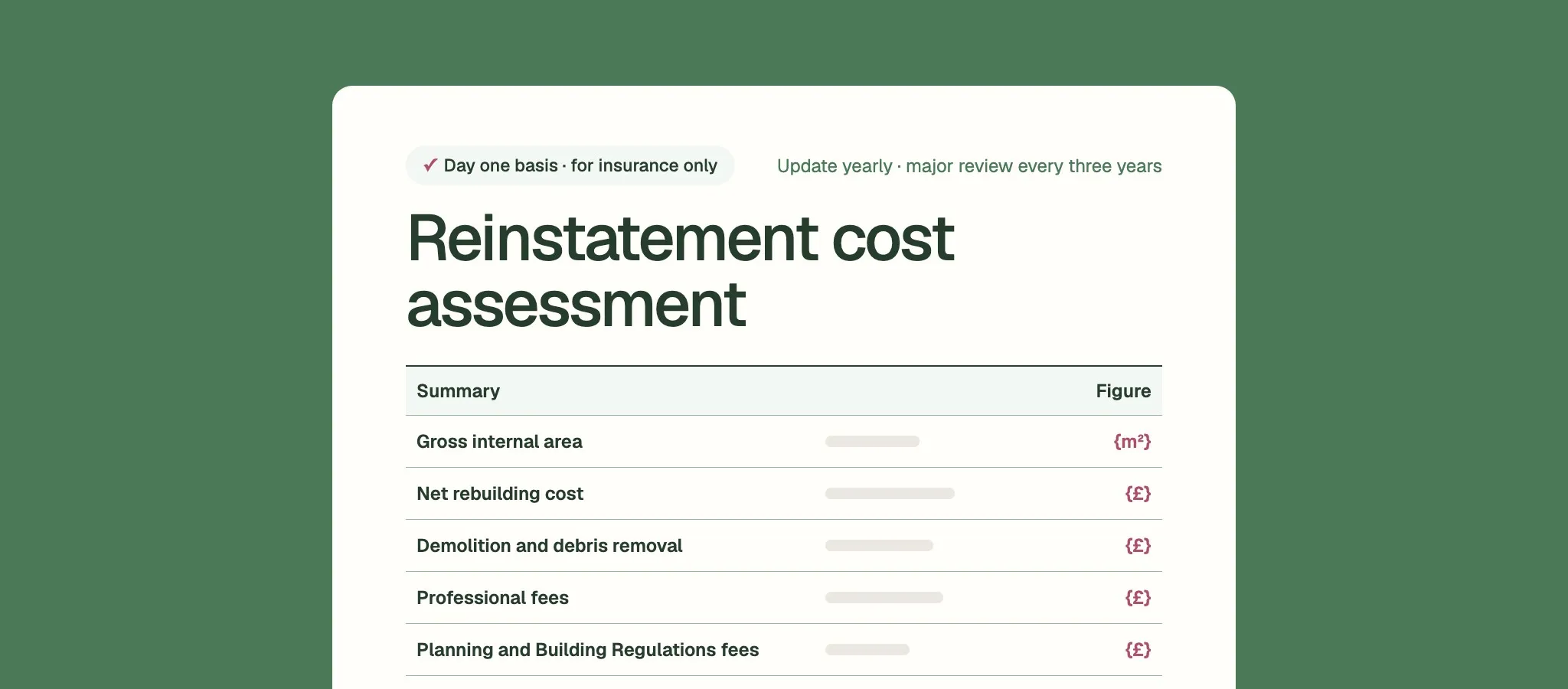
Reinstatement cost assessment
For insurance only. It isn't a valuation.
Property
Basis of assessment
Day one reinstatement
Date of assessment
Prepared by
Gross internal area
{m²}
Measured on site to RICS property measurement
Net rebuilding cost
{£}
Gross internal area × a suitable rebuilding rate
Demolition and debris removal
{£}
Including shoring up party walls where needed
Professional fees
{£}
Architects, engineers, surveyors and others the rebuild needs
Planning and Building Regulations fees
{£}
Checked at the time of the assessment
Total, rounded
{£}
Say whether it includes VAT
Reinstatement period
{months}
The declared value for insurance purposes has no direct relationship to the market value of the property.
The parts of an assessment summary, following the example report in RICS's professional standard. Figures are left out.
What RICS's example report leaves out
Tenants' fit-out, fixtures, fittings and furnishings
Clean-up of contaminated land
Alternative accommodation while the building is rebuilt
Loss of rent
Plant and machinery, contents and other insurances
Settle the inclusions and exclusions in your instructions. RICS says surveyors should establish what's to be insured, taking particular care over fixtures and tenants' fittings that the lease requires the landlord to insure.
How often should a reinstatement cost assessment be reviewed?
RICS says it's prudent to recommend an annual adjustment for inflation and a major review and reassessment every three years, or sooner if the building is significantly altered. Its example report suggests a desktop update each year and a major review every third year, with a full assessment after any substantial alterations.
From RICS's Reinstatement cost assessment of buildings, paragraph 3.6 and the example report in appendix B.
When
What to do
Every year
Adjust the figure for inflation, usually as a desktop update
Every three years
A major review and reassessment
After significant alterations
A full assessment, without waiting for the next review
Indexing alone won't keep the figure right. RICS points out that the cost of meeting current regulations changes too, so inflation isn't the only thing that moves.
Who carries out a reinstatement cost assessment?
A surveyor, after visiting the site and measuring the building. RICS members must follow RICS's professional standard on reinstatement cost assessment, and its example report is signed on behalf of the surveying firm. Desktop assessments without a site visit fall outside the standard, and insurers may not accept them as a basis for cover.
For houses and flats, RICS points to the rebuilding cost guidance in BCIS's Rebuild Online service. Larger homes, higher specifications and mixed-use buildings that fall outside those models follow the standard instead.
The figure is for insurance only
RICS's example report says the assessment is for insurance reinstatement only, gives no advice on the property's condition, and isn't appropriate for any other purpose. Preparing it isn't a regulated activity, but advising on the need for and scope of insurance cover is, so don't stray into that unless your firm is authorised.
Where can AI help with a reinstatement cost assessment?
AI helps most with the report around the figure. It can turn site notes, photos and measurements into the property description, draft the standard sections and caveats, and check that every inclusion and exclusion is stated. The rebuilding rate, the allowances and the final figure stay with the surveyor, who checks every line before it goes out.
Give it
Your site notes, photos and measurements
Last year's report for the same building
Your standard caveats and declarations
The client's instructions and the basis of cover
Always check
The floor areas and the rebuilding rate
The allowances for demolition and fees
Inclusions and exclusions match the instructions
The description matches what you saw on site
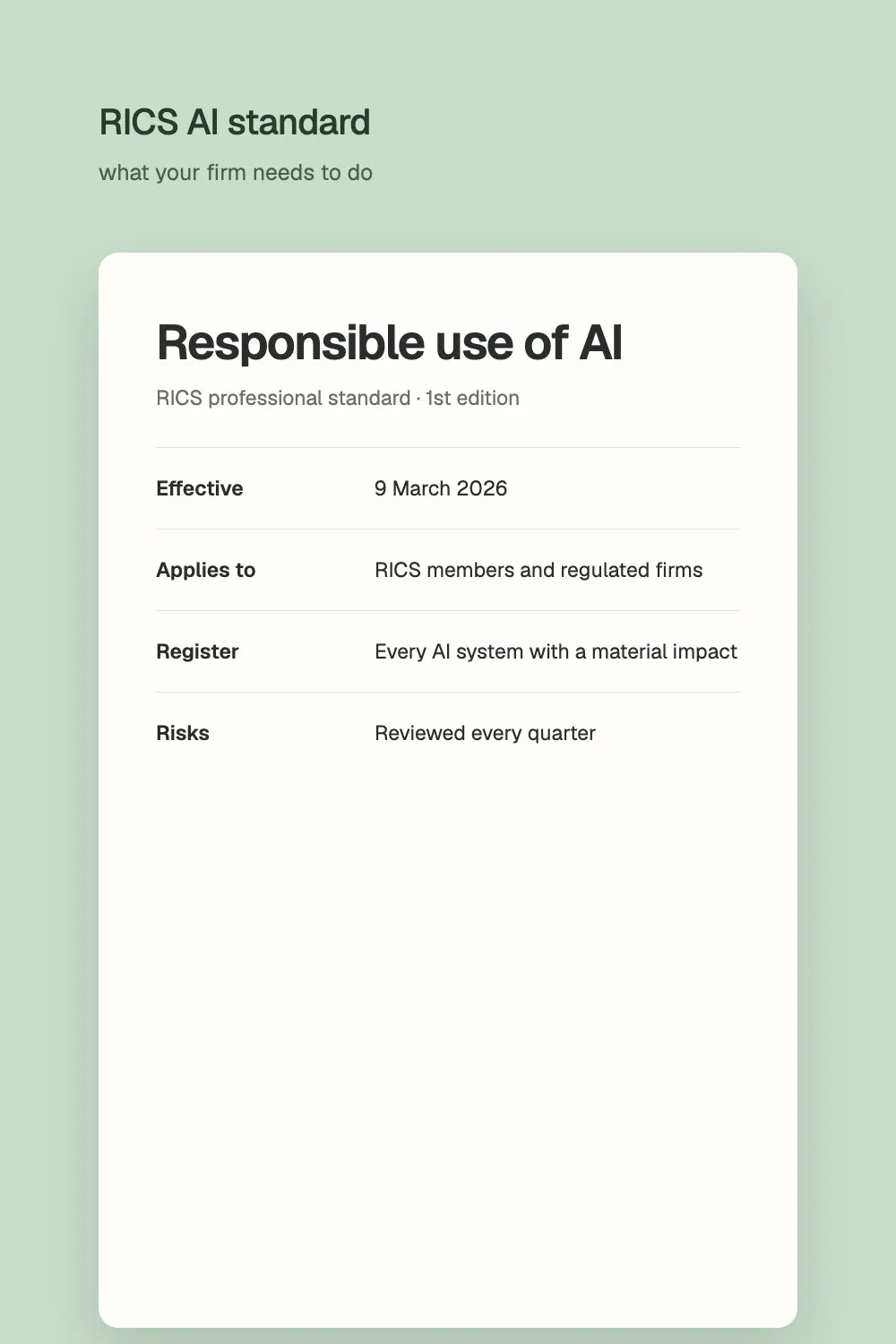
Since 9 March 2026, RICS's standard on responsible use of AI has applied to RICS members and regulated firms. If an AI output has a material impact on the assessment, you need a written decision on whether it's reliable, made by or under a named surveyor. The RICS AI standard guide covers the rest.
Which office job should your firm hand to AI first?
The role under JCT and NEC4, the paperwork, and where AI helps
How long does each reinstatement cost assessment take your team?
The check puts survey reports, including reinstatement cost assessments, next to the rest of your office work and shows which job AI should take on first. Free. Any work after it is agreed separately.