RICS's standard on the responsible use of AI in surveying practice has applied since 9 March 2026. Here's who it covers and what your firm needs in place, as a checklist, with a free register to start from.
The standard supports using AI. What it asks is that you know where you use it, write down why, check what it produces and tell your clients. Most of it is records and policy, and this page goes through each part in the order the standard sets it out.
What is the RICS AI standard?
It's an RICS professional standard called Responsible use of artificial intelligence in surveying practice. The 1st edition was published in September 2025 and took effect on 9 March 2026. It applies worldwide and sets mandatory requirements, marked by the word "must", for how members and RICS-regulated firms use AI to deliver surveying services.
The standard at a glance
Title
Responsible use of artificial intelligence in surveying practice
Type
RICS professional standard, global
Edition
1st edition, September 2025
In force from
9 March 2026
Applies to
RICS members and RICS-regulated firms, in every country
Covers
AI outputs with a material impact on a surveying service
If the law says otherwise
The law wins. Record the conflict and report it to RICS
Who does the RICS AI standard apply to?
It applies to RICS members and RICS-regulated firms in every country. Its requirements apply when an AI output has a material impact on the surveying service, such as a document summary you rely on in a report, or a suggestion about which part of a building to investigate. If you decide your use is material, record that decision and why.
Some duties fall on each member who uses AI, such as knowing the basics. Most fall on the regulated firm: the registers, the policies, the supplier checks and the client terms.
Does it cover tools like ChatGPT and Copilot?
Yes, if what they produce has a material impact on your surveying service. The standard covers AI built for surveying and AI built for general business use alike, and it's the use of the output that counts. Outputs that are incidental or unrelated to delivering the service fall outside it.
What does your firm need to do?
Make sure everyone using AI understands the basics, protect confidential data, write down why AI is the right tool, keep a register of AI systems and a risk register, check suppliers in writing, record whether each material output is reliable, and tell clients in writing before AI is used on their work.
1
Learn the basics
Every member using AI · section 2
Understand the main types of AI and their limits, the risk of wrong output, the risk of bias, and the risks around the data you use.
2
Protect confidential data
Your firm · section 3.1
Store it securely, limit access to the people who need it, and train them at least once a year. Anonymise data where you can. Don't upload private or confidential data to AI unless the people affected have given written consent in advance and you're satisfied the risk is acceptable.
3
Write down why AI is the right tool
Your firm · section 3.2
Before using AI with a material impact, record in writing whether AI is the most appropriate tool, having weighed the task, the alternatives, environmental and stakeholder impact, data risks, and the risk of wrong or biased output. A written policy that you review from time to time can do this.
4
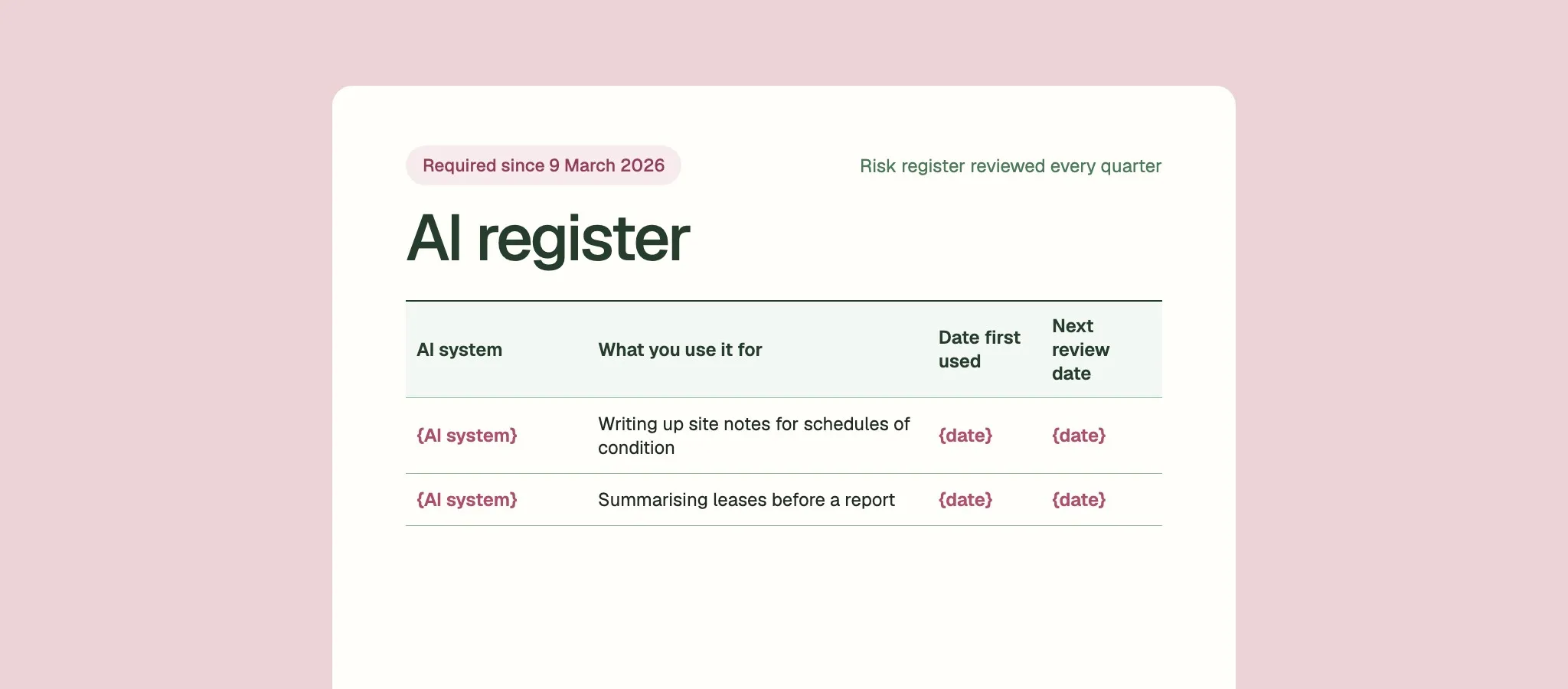
Keep an AI register
Your firm · section 3.2
List each AI system with a material impact, what you use it for, the date you first used it and the date you'll next review it.
5
Have a responsible-use policy
Your firm · section 3.2
Set out who is responsible for what, training at least once a year, how people check AI work, for example by dip-sampling outputs, and how to spot and reduce the risks.
6
Keep a risk register
Your firm · section 3.3
Cover bias, wrong outputs, limited information about the system and its training data, and what happens to the data you put in. Give each risk a likelihood, impact, plan, risk appetite and red, amber or green rating, and review the register at least every quarter.
7
Check suppliers in writing
Your firm · section 4.1
Before buying an AI system with a material impact, ask the supplier in writing about its environmental impact, who was involved in building it, data law compliance, permissions for personal data, its training data, and its liability. Record the answers and any testing you did.
8
Decide in writing whether each output is reliable
Members and firms · section 4.2
Record your assumptions, concerns and conclusion, prepared by or under a named surveyor who accepts responsibility. For automated or high-volume use, dip-sample outputs at regular intervals instead. If an output can't be used, tell the client in writing.
9
Tell clients before you use it
Members and firms · section 4.3
Say in writing, in advance, when and why AI will be used. Your terms must also cover which parts of the service involve AI, professional indemnity cover for AI if it's available, how to contest its use, how to seek redress, and whether clients can opt out.
10
Be ready to explain it
Your firm · section 4.4
On request, give written information on the type of AI you used, how it works and its limits, your supplier checks, how you manage the risks, and your reliability decisions.
If your firm builds its own AI systems, section 5 of the standard adds more, including a written sustainability impact assessment and written permission from anyone whose personal data is used in development.
Risk register
Review at least every quarter
Risk
Likelihood
Impact
Plan to mitigate and manage it
Risk appetite
RAG
Bias in the AI system and its outputs
Wrong outputs from the AI system
Limited information about the AI system and its training data
Retention or use of the data you put into the AI system
The Excel file has the AI register, this risk register and a reliability decision record, with the columns the standard lists.
The four risks in the first column are the ones the standard says the register must cover.
What happens if your firm doesn't comply?
RICS says it will take its professional standards into account in regulatory or disciplinary proceedings when deciding whether a member or firm acted appropriately and with reasonable competence. It also says a judge or adjudicator is likely to take them into account in legal proceedings.
How does the standard fit with an AI policy?
The standard asks regulated firms for written policies on responsible use, either standalone or added to existing IT, data protection and client engagement policies. The AI policy template is a two-page starting point for the everyday rules. Add the RICS parts to it: the registers, supplier checks, reliability decisions and client terms.
Which office job should your firm try AI on first?
The role under JCT and NEC4, the paperwork, and where AI helps
Where would AI save your firm the most hours?
The check ranks your office jobs by the hours they take and gives you a one-page plan, including the rules to agree before a trial. Free. Any work after it is agreed separately.