Contract administration in construction: the role, the paperwork and where AI helps
Last checked 4 October 2026
What the contract administrator does under JCT and NEC4, the paperwork that comes with the role, and how AI can take on the letters, notices and records while contract positions stay with you.
Contract administration is mostly paperwork against the clock: instructions, valuations, certificates and notices, each with a date that matters. The decisions behind them need judgement. The drafting, logging and chasing around them are where AI can give you time back.
What is contract administration in construction?
Contract administration is running a building contract once it's signed: issuing instructions, valuing work, certifying payment and completion, and dealing with delays and changes. Under JCT's Standard Building and Minor Works contracts, the role belongs to the Architect/Contract Administrator. NEC4's Engineering and Construction Contract splits it between a Project Manager and a Supervisor.
What does a contract administrator do under JCT?
JCT's guidance describes the Architect/Contract Administrator as the professional the employer appoints to advise on and administer the contract. They're paid by the employer, but should act fairly and independently between employer and contractor when certifying payment, valuing variations, extending time and certifying completion. Only they can issue instructions to the contractor.
Issue instructions to the contractor. The employer can't instruct directly.
Value variations and work against provisional sums.
Issue interim certificates for payment, and the final certificate.
Give a reasonable extension of time when delay is beyond the contractor's control.
Certify practical completion.
Certify when defects that appear in the rectification period have been made good.
If the person appointed isn't an architect, the contract calls them the Contract Administrator. The duties are the same.
Who administers an NEC4 contract?
NEC4's Engineering and Construction Contract names two roles, both appointed by the client. The Supervisor checks the work against the Scope, looks after tests and inspections, and notifies defects. The Project Manager handles most of the rest, including instructions, the programme, compensation events, and certifying payment and completion.
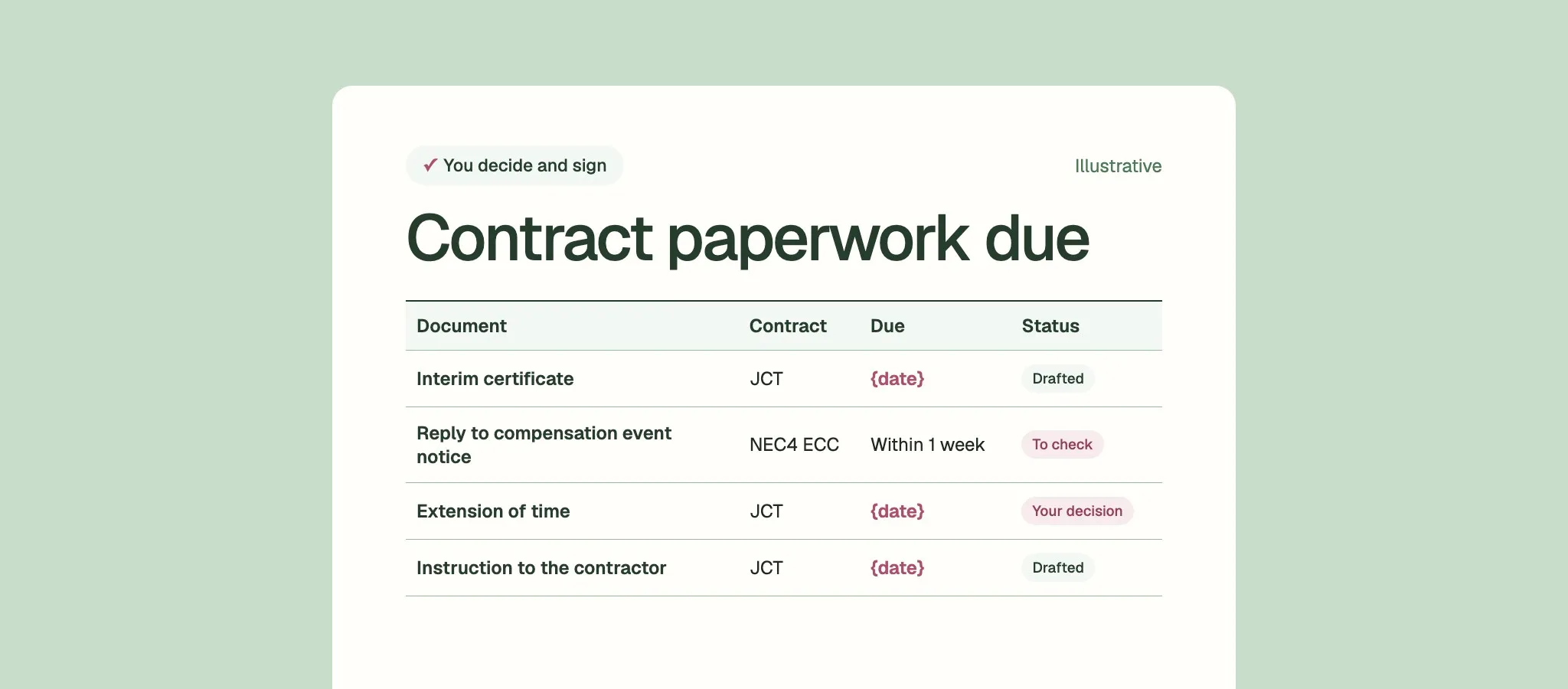
NEC4 runs on early warnings, an accepted programme and compensation events. In most cases the contractor must notify a compensation event within eight weeks of becoming aware of it, or lose the right to more time or money. The Project Manager has one week to reply to a notification unless a longer period is agreed, and a late reply can mean a notification, a programme or a quotation is treated as accepted.
Compared on
JCT Standard Building or Minor Works
NEC4 Engineering and Construction Contract
Who runs it for the client
Architect/Contract Administrator
Project Manager, with a Supervisor for tests and defects
Changes
Instructions, with variations valued
Compensation events, 21 of them listed in clause 60.1
Delay
Extension of time
Compensation events, assessed against the accepted programme
Payment
Interim certificates, pay less notices and a final certificate
The Project Manager certifies payment
Completion
Practical completion and making good certificates
The Project Manager certifies completion, and the Supervisor issues the defects certificate
What paperwork does contract administration involve?
Mostly instructions, certificates and notices, each with a date that matters. JCT publishes model forms for them, including the instruction, interim and final certificates, pay less notice, extension of time, and practical completion and making good certificates. Under the Construction Act, a construction contract must provide for a payment notice no later than five days after each payment's due date.
The paperwork on a JCT job
Minor Works, 2024 edition
Instructions
Architect/Contract Administrator's instruction
Payment
Valuation
Interim certificate
Pay less notice
Final certificate
Time
Extension of time
Non-completion
Notice of intention to deduct liquidated damages
Completion
Practical completion certificate
Certificate of making good
The model forms JCT publishes for the Minor Works Building Contract 2024, grouped by what they deal with. The Standard Building Contract pack adds more, such as section completion and partial possession.
Behind every form sit the records that justify it: site diaries, minutes, letters and, on an NEC4 job, the early warning register. Keeping them up to date takes time every week, and they're what you'll rely on if there's a dispute.
Where can AI help with contract administration?
AI is good at the paperwork around each decision: drafting instructions, letters and notices from your notes, keeping registers up to date, turning site diaries and correspondence into records, and flagging dates coming due. Whether something is a variation or a compensation event, what it's worth, and anything signed or sent stay with the contract administrator.
Give it
Your site diary and meeting notes
Letters and emails on the job
The contract's dates and notice periods
Your standard letter wording
Always check
Every date and notice period against the contract
Clause references
The facts match the records
Nothing commits you to a position you haven't decided
Response times matter most under NEC4. A weekly list of what's coming due, checked by a person against the contract, is a good first job to hand to AI.
Are contract letters your biggest drain, or is it something else?
Anything that takes a position under the contract: whether an event entitles the contractor to more time or money, what a variation is worth, whether the work is complete, and the wording of anything you sign or send. AI can gather the facts and draft. The contract administrator decides and signs.
The AI in construction guide lists the other office jobs AI helps with, and the ones it shouldn't touch yet.