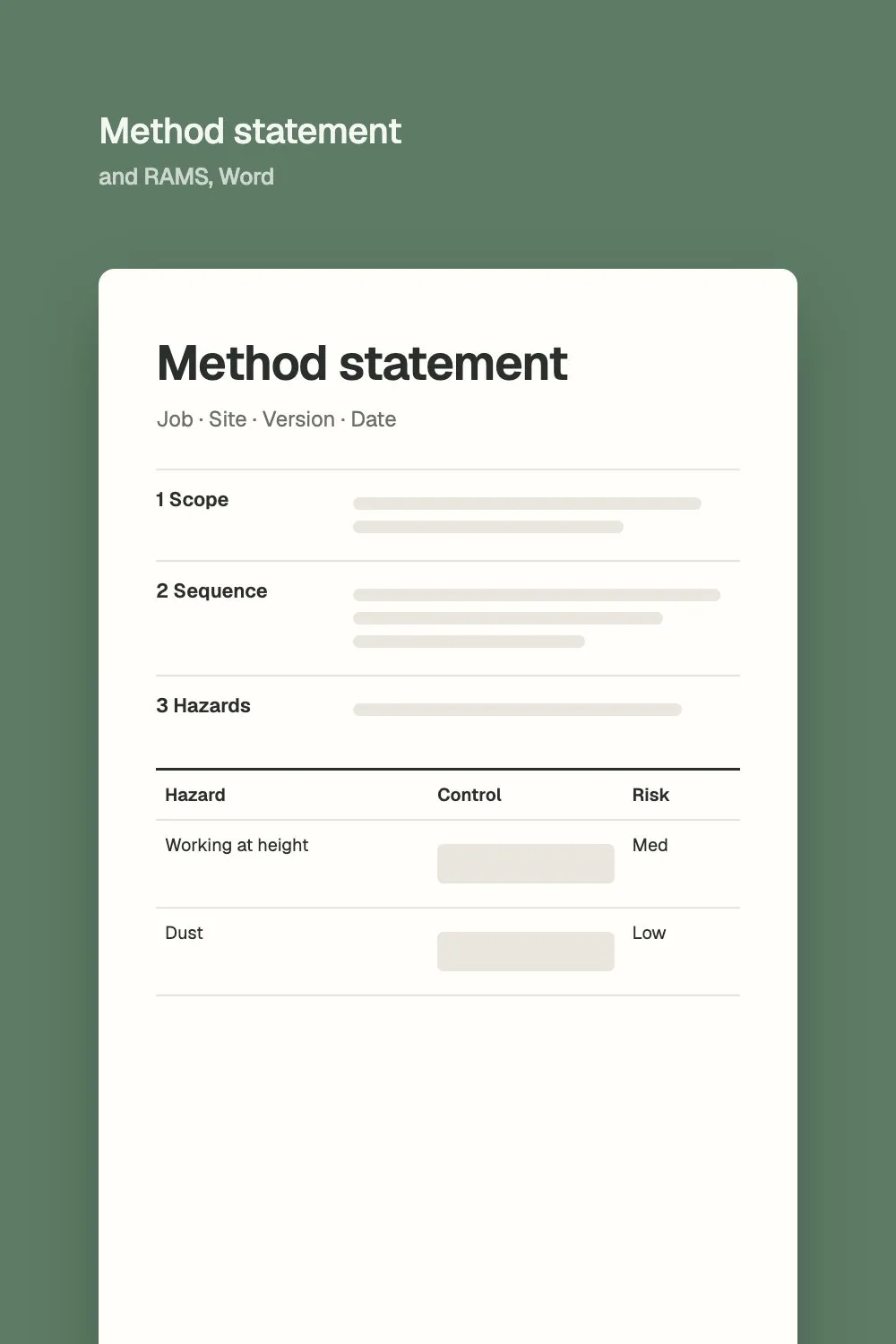
Method statement and RAMS
With the risk assessment table and a briefing record
A free risk assessment template for construction work in Word and PDF, set out in HSE's five steps, with a filled-in example.
Last checked 5 October 2026
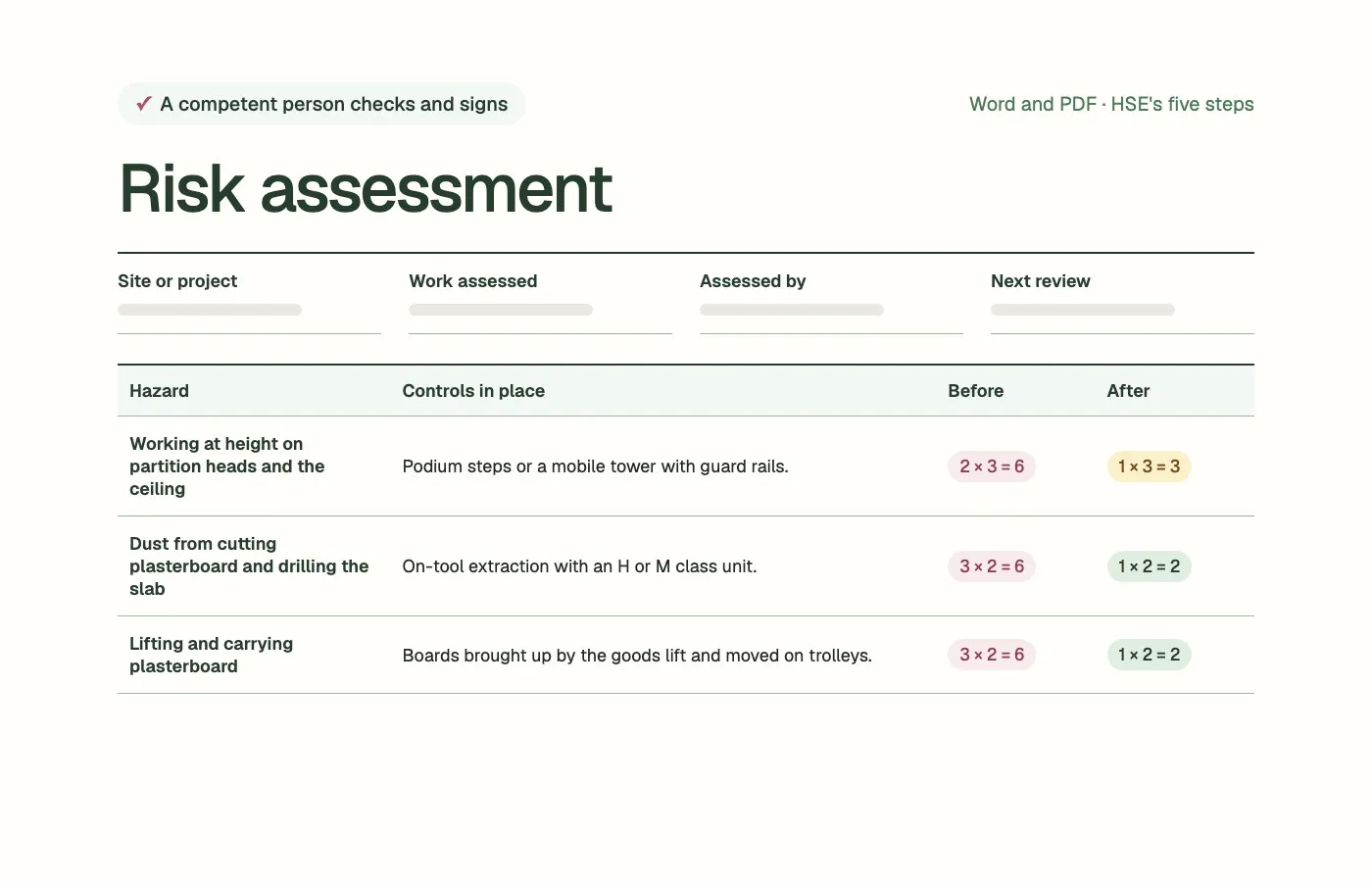
A construction risk assessment works out what on a job could hurt someone, who could be hurt and how, and what you'll do to stop it. You write it before work starts, share it with the people doing the work and review it when anything changes. Every employer must make one.
Yes. Under the Management of Health and Safety at Work Regulations 1999, every employer must make a suitable and sufficient assessment of the risks to their workers and to anyone else affected by the work. With five or more employees, you must record the significant findings and any group of workers found to be especially at risk.
On a construction site, CDM 2015 adds two things. You must tell your workers about the risks your assessment identifies. And where more than one contractor is on the project, you follow the parts of the principal contractor's construction phase plan that apply to your work.
Sources: Management Regulations 1999, regulation 3; CDM 2015, regulation 15.
HSE sets out five steps. Work through them for each task, on the site you're actually working on.
Identify the hazards. Look at the task, the equipment, the materials and the building. Check your accident and near-miss records, and ask the people who'll do the work.
Assess the risks. Decide who could be harmed and how, how likely it is, how serious it could be, and what you already do about it.
Control the risks. Remove the hazard if you can. If you can't, control it so harm is unlikely.
Record your findings. The hazards, who could be harmed and how, and what you're doing about them. Required once you have five or more employees.
Review the controls. Check they're working, and look again when something changes.
HSE splits them into safety hazards, such as working at height, excavations, lifting, electricity, fire, demolition, and plant and vehicles, and health risks, such as dust, asbestos, cement, chemicals, noise, vibration and manual handling. Most jobs carry several of each.
| On a typical site | |
|---|---|
| Safety | Working at height, excavations, lifting operations, electricity, fire, mobile plant and vehicles, demolition, slips and trips |
| Health | Dust and silica, asbestos, cement, chemicals, noise, vibration, manual handling |
Construction had more worker deaths than any other industry in 2025/26: 25 of the 126 recorded in Great Britain. Falls from height were the most common cause of death at work across all industries, with 31. Both figures are HSE's provisional ones.
In any building put up before 2000, check for asbestos before you drill, cut or strip out. HSE says employers must identify it as part of their risk assessment, and the owner or manager of a non-domestic building must make their asbestos record available to you.
Your own workers first, then other contractors, visitors, delivery drivers, members of the public and anyone using the building while you work. HSE also asks you to think about workers with particular needs: young workers, migrant workers, new or expectant mothers and people with disabilities.
First ask whether you can get rid of the hazard altogether. If you can't, control the risk so harm is unlikely, starting with measures that protect everyone and ending with personal protective equipment (PPE). The Management Regulations put protecting everyone before protecting individuals.
Remove the hazard: do the work another way, or somewhere safer, such as on the ground.
Replace it: with a less hazardous material, tool or method.
Keep people away from it: barriers, guard rails, edge protection, on-tool extraction.
Organise the work: sequence, time limits, permits, supervision and training.
Personal protective equipment: the last line, once everything above is in place.
For work at height the order is set in law: avoid it where you reasonably can, prevent falls where you can't, and reduce the distance and consequences of a fall where the risk remains. Across all of it, you're expected to do what's reasonably practicable, weighing the risk against the money, time and trouble of controlling it.
HSE asks you to decide how likely it is that someone could be harmed and how serious it could be. The template turns that into a score: likelihood from 1 to 3, times severity from 1 to 3. Rate each hazard before and after the controls, so you can see what the controls achieve.
| Risk | Score | What to do |
|---|---|---|
| Low | 1 to 2 | Keep the controls in place. |
| Medium | 3 to 4 | Reduce it further where you reasonably can. |
| High | 6 to 9 | Don't start until it's lower. |
When there's reason to think it's no longer valid, or something significant changes: the work, the team, the equipment, the materials or the site. Look again after an accident or near miss, or when workers spot a problem, and update the record with what you change.
No. The risk assessment works out what could go wrong and how you'll control it, and the law requires it. A method statement sets out how the work will be done, step by step, so those controls actually happen. No law names it, but clients and principal contractors usually ask for one.
Together they're known as RAMS. If you need both in one document, use the method statement and RAMS template.
One per job or task, with a row for each hazard. The hazards table sits on a landscape page in the Word file, so there's room to write.
Risk assessment
A competent person checks this against the site and signs it before work starts.
Who might be harmed
Tick everyone the work could affect, and note anyone at particular risk.
Risk rating
Score each hazard before and after the controls: how likely it is, times how bad it could be.
| Severity | 1 Unlikely | 2 Possible | 3 Likely |
|---|---|---|---|
| 1 Minor injury | 1 | 2 | 3 |
| 2 Injury or ill health with time off work | 2 | 4 | 6 |
| 3 Major injury, lasting ill health or death | 3 | 6 | 9 |
Hazards and controls
One row per hazard. Rate the risk before and after the controls.
| Hazard | Who might be harmed and how | Controls in place | Risk before | Further controls needed | Risk after | Action by | By when |
|---|---|---|---|---|---|---|---|
Choosing controls
Start at the top and work down. Protecting everyone comes before protecting one person.
1Remove the hazard
Do the work another way, or somewhere safer, such as on the ground.
2Replace it
With a less hazardous material, tool or method.
3Keep people away from it
Barriers, guard rails, edge protection, on-tool extraction.
4Organise the work
Sequence, time limits, permits, supervision and training.
5Personal protective equipment
The last line, once everything above is in place.
Briefing record
Everyone doing the work is told the hazards and controls before starting, and signs here.
| Name | Company | Signature | Date |
|---|---|---|---|
Review record
Review it when the work, the team, the equipment or the site changes, and after any accident or near miss.
| Date | What changed | Changes made to this assessment | Reviewed by |
|---|---|---|---|
Sign-off
A competent person checks this against the site and signs it before work starts.
| Name | Position | Signature | Date | |
|---|---|---|---|---|
| Assessed by | ||||
| Checked by (competent person) | ||||
| Accepted by principal contractor (if required) |
One fit-out job with five hazards, at the level of detail to aim for. Use it to check your own, not to copy. HSE warns that putting your name on someone else's example won't satisfy the law.
Strip-out and new stud partitions on an occupied office floor
Second floor of a 1980s office block. The rest of the floor stays in use.
1Asbestos in the walls or ceiling
Our team breathing in fibres if hidden material is disturbed. Office staff nearby.
Building's asbestos record checked for every area being stripped out before work starts. Anything that looks suspect: stop, keep people out and report it.
2Working at height on partition heads and the ceiling
Our team falling from steps or a tower.
Podium steps or a mobile tower with guard rails. Stepladders only for light work of 30 minutes or less. Pre-use check on every ladder and tower.
3Dust from cutting plasterboard and drilling the slab
Our team and office staff breathing it in.
On-tool extraction with an H or M class unit. Boards cut in one area away from staff. FFP3 masks, face-fit tested, where extraction isn't enough.
4Lifting and carrying plasterboard
Our team straining their backs.
Boards brought up by the goods lift and moved on trolleys. Two people to every carry. Board lifter for ceiling-height work.
5Office staff and visitors near the work
Tripping on materials or being hit by falling items.
Barriers and signs around the work area. Materials stored inside it. Fire exits and corridors kept clear. Hours agreed with the building manager.
It can draft one from the job details and your past assessments, which saves retyping the hazards that come up on every job. It can't see the site, so a competent person checks every hazard and control against the real work and signs it.
Give it
Always check
HSE plans to publish guidance during 2026/27 on how health and safety law applies to AI. Until then, the assessment is yours, whoever drafted it.
With the risk assessment table and a briefing record
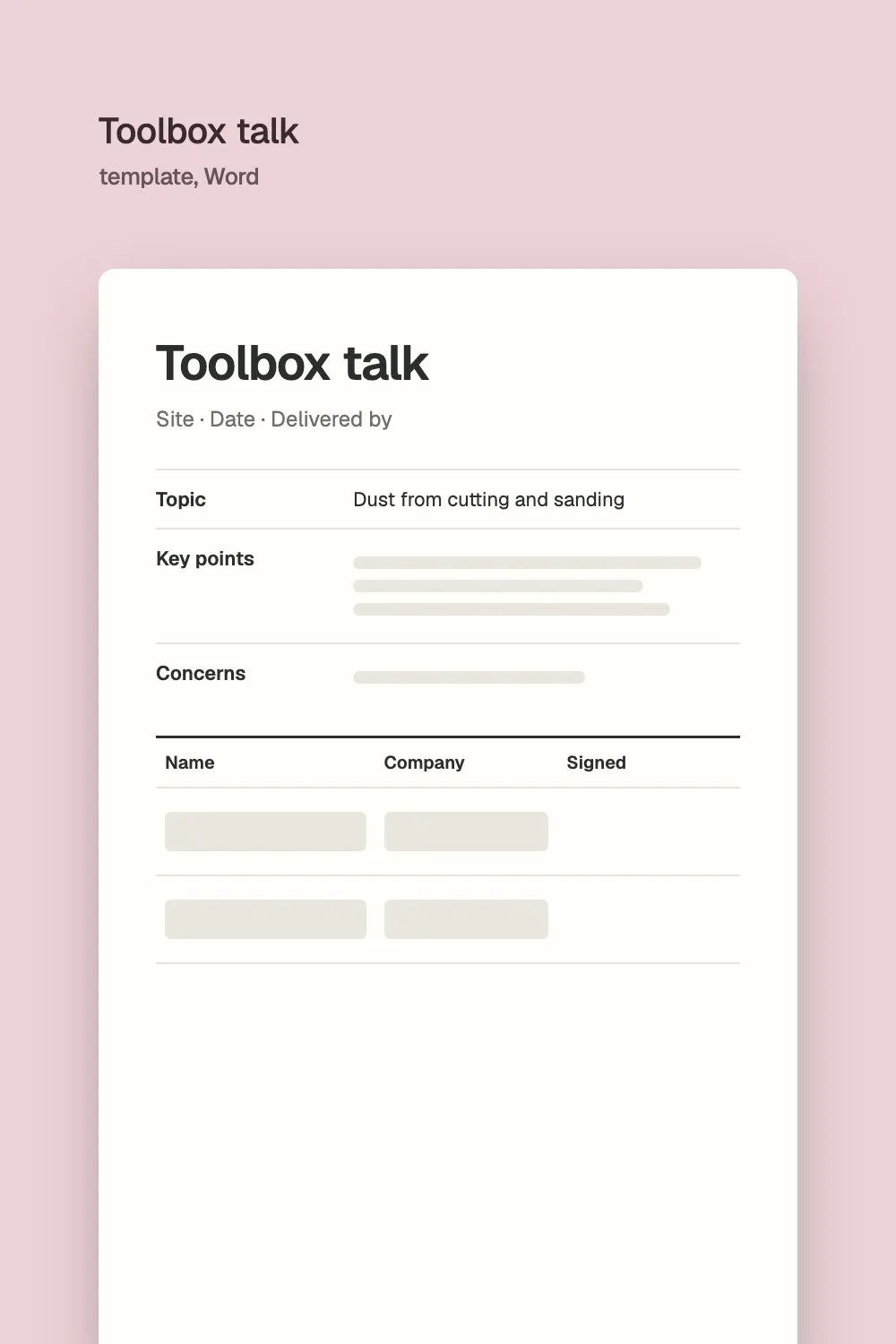
One page with an attendance record, plus five starter talks
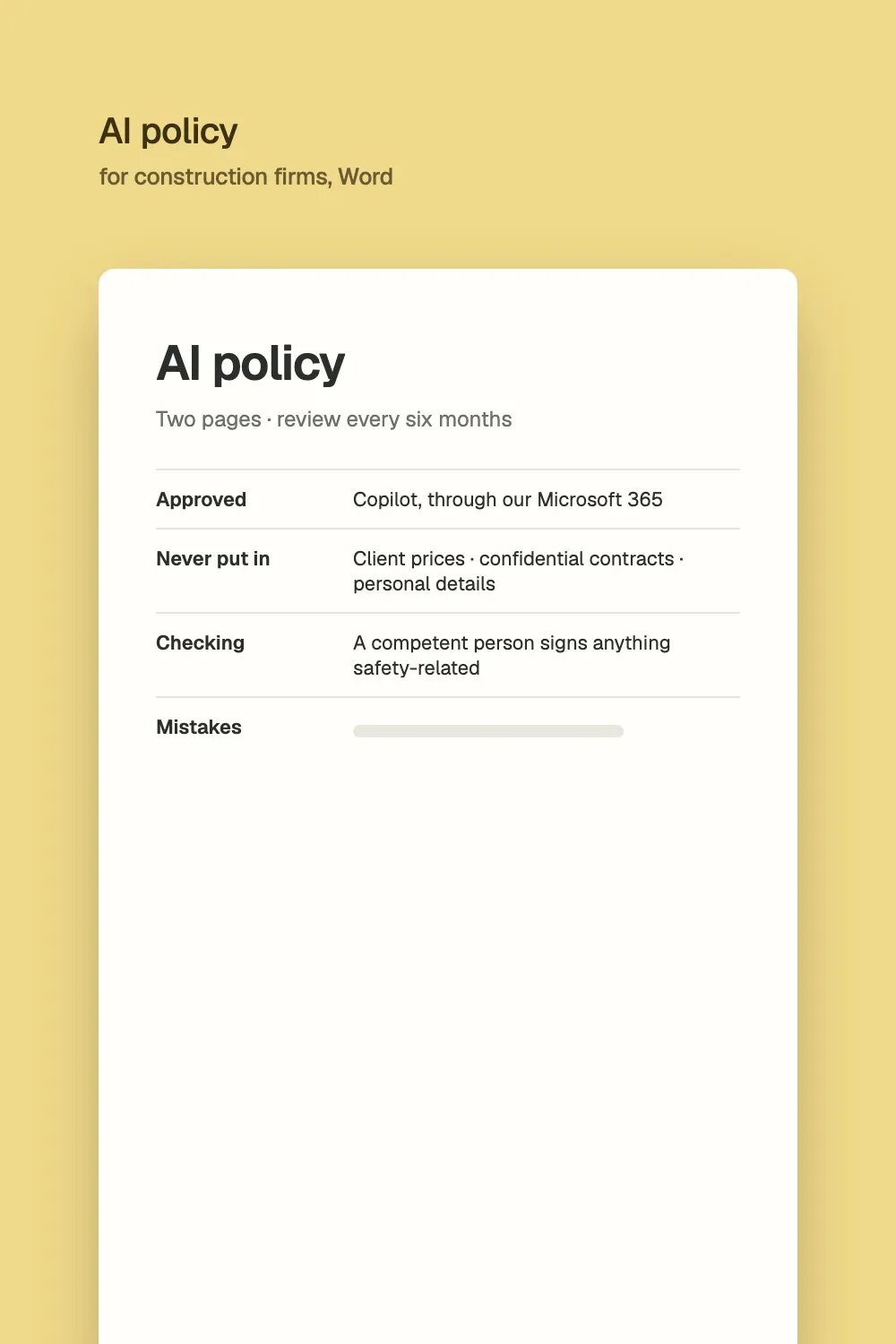
Two pages your team can follow from Monday