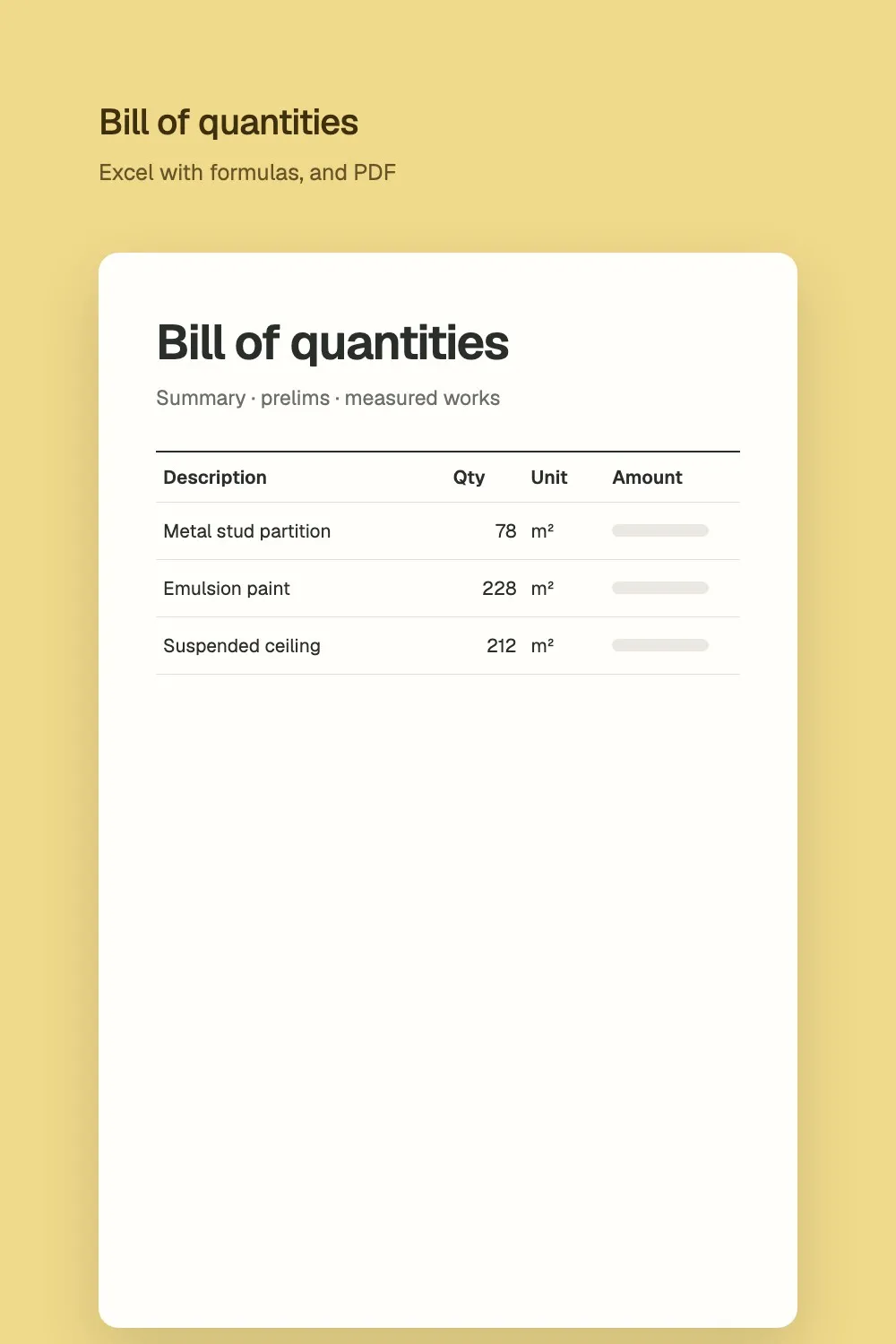
Bill of quantities
Sums set up in Excel, plus how NRM 2 lays out a bill
A free quote template in Word, with an Excel version that adds up the price, the allowances and the VAT for you.
Last checked 5 October 2026
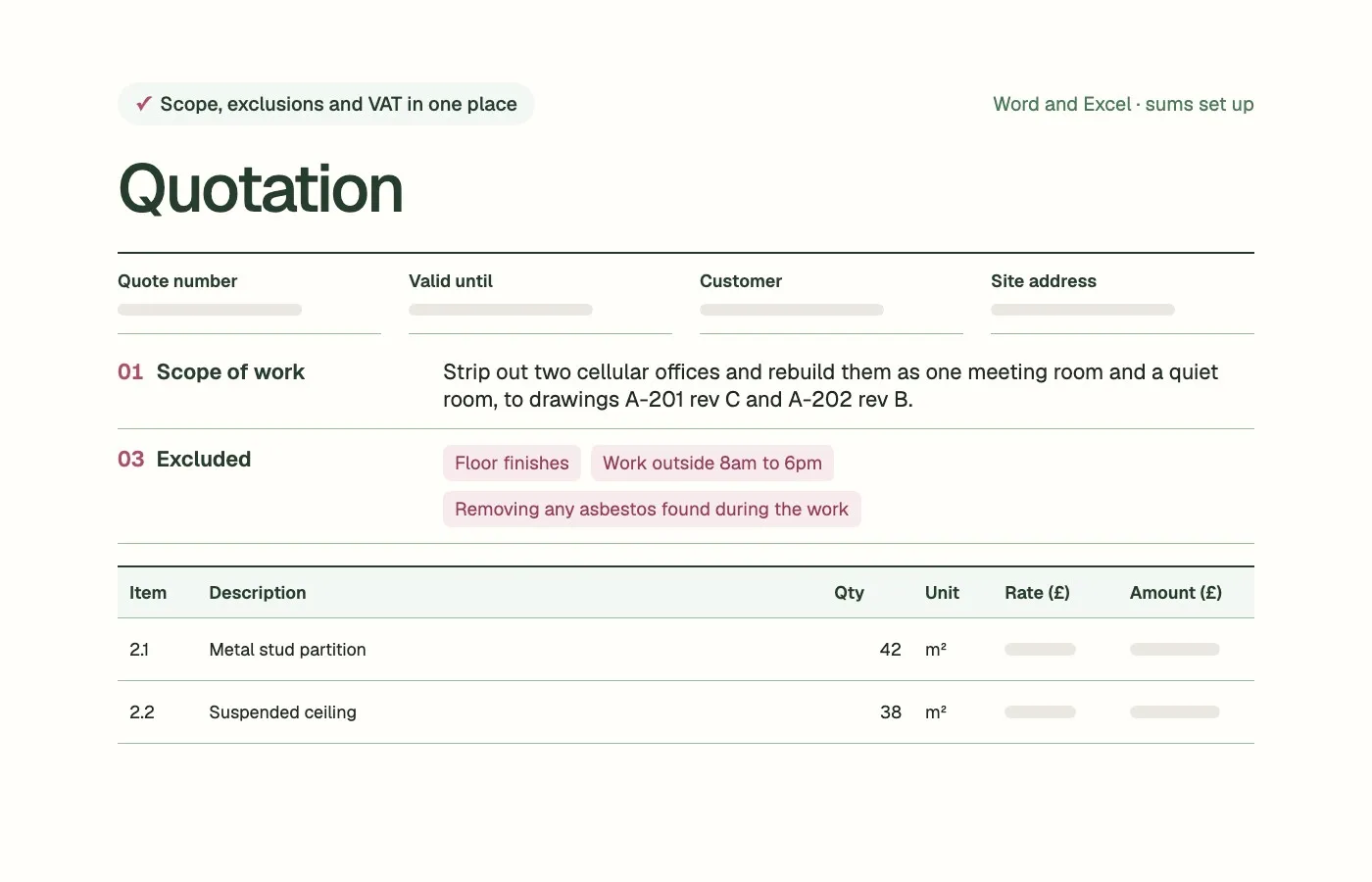
A construction quote sets out the work you'll do, what the price includes and leaves out, the price with any provisional or PC sums, the VAT, when you can start, how long the price holds, how you'll be paid and how the customer accepts. Written down, it's the record of what was agreed.
Scope of work: what you'll do, and the drawings or enquiry it's priced from.
Included: materials, labour, plant, waste and making good.
Excluded: anything a customer might assume is in.
Assumptions: access, hours and services on site.
Price: items, quantities, rates and section totals.
Provisional sums and PC sums: allowances, adjusted to the actual cost.
Totals and VAT: net total, the VAT rate and the total.
Programme: start date, duration and working hours.
Validity: how long the price holds.
Payment terms: stages or monthly, due dates and final dates.
Acceptance: who signs, and how to accept.
No. A quote is a fixed price for the work described. An estimate is a best guess that can change. Once the customer accepts a quote, it's a binding agreement whether or not it's written down. Extra work they ask for, or agree to pay for, is priced on top.
Citizens Advice tells homeowners to look for a fixed total, a breakdown of the work and materials, how long the price is valid, whether it includes VAT, and when it can go up. The template covers each one. Price any extra work before you do it, on a variation order.
Inclusions say what the price covers, so the customer can compare quotes like for like. Exclusions say what it doesn't, so nobody assumes a job is in. Write both as short lines, specific to this job.
Often included
Often excluded
Add the assumptions the price depends on, such as access, working hours, and power and water on site. If one turns out wrong, the price can be looked at again.
Both are allowances for things you can't price exactly yet. A provisional sum covers work that can't be fully described, such as repairs you'll only see once the floor is up. A PC (prime cost) sum covers materials the customer hasn't chosen, such as tiles or door handles, priced as supply only.
| Provisional sum | PC sum | |
|---|---|---|
| What it covers | Work that can't yet be described or measured in full | Materials or goods whose exact quality isn't known yet, supply only |
| Example | Repairs to the floor screed once old partitions come out | Door ironmongery, client to choose |
| What it leaves out | Overheads and profit, priced separately | Fixing, sundries, overheads and profit |
On larger jobs priced from a bill of quantities, provisional sums get a bill of their own. The bill of quantities template sets one out.
Show the price before VAT, the VAT rate and the VAT, then the total. Most building work is standard-rated at 20%. Building a new home is usually zero-rated, and some conversions and work on homes empty for two years or more can be 5%. HMRC's VAT Notice 708 sets out which.
Quoting a homeowner? Give them the total including VAT. The CMA's guidance says a price given to consumers must include any taxes they'll have to pay.
It applies when you and your customer are both VAT-registered, the work is reported under the Construction Industry Scheme (CIS), and it's standard- or reduced-rated. That's the usual position when a subcontractor quotes a contractor. It doesn't apply to homeowners, to zero-rated work, or to a business that has told you in writing it's an end user, meaning it isn't passing the work on.
When it applies, your customer pays the VAT to HMRC instead of you. Show the VAT, leave it out of the total, and add a line such as "Reverse charge: VAT Act 1994 section 55A applies. Customer to pay the VAT to HMRC." The Excel version has a switch for it.
Say when you'll apply for payment, in stages or monthly, when each payment falls due, and the final date for payment. The Construction Act gives you the right to stage payments on any job lasting 45 days or more, and every contract needs a due date and a final date for each payment.
The contract must also provide for a payment notice, giving the sum due and how it's worked out, within five days of each due date. The Act doesn't cover work on a home the customer lives in. How your terms play out in the bank is covered in the construction cash flow guide.
Long enough for the customer to decide, and short enough that your material prices still hold. Give a date rather than a number of days, and say what happens after it, for example that you'll check prices before you confirm.
Ideally in writing: a signature on the acceptance section, or an email quoting the quote number. Once they accept, you have a contract, so attach any terms you want to rely on before they sign.
If you agree the job with a homeowner away from your premises, at their home or by phone or email, they usually have 14 days to cancel. Give them the cancellation information, and start within those 14 days only if they ask you to in writing. If they then cancel, they pay for the work done so far, provided you gave them that information. New-build work isn't covered.
The Word version is the quote you send. The Excel version prices it: each line multiplies out, the sections add up, and the VAT and total follow the rate and reverse charge setting you pick.
Quotation
Check the scope, exclusions and figures against the enquiry before you send it.
{Your company name} · {Address} · {Phone} · {Email} · VAT no. {number} · Company no. {number}
01Scope of work
Describe the work in the order you'll do it. Name the drawings, specification or enquiry you've priced from, with their revision.
02Included
List what the price covers: materials, labour, plant, waste removal, protection, making good and cleaning.
03Excluded
List what the price doesn't cover, so nobody assumes it's in. For example: fees, out-of-hours work, asbestos removal, or decoration outside the work area.
04Assumptions
The conditions the price depends on, such as clear access, working hours, and power and water on site.
05Price
One line per item, grouped into sections. The Excel version works out every amount and total.
| Item | Description | Qty | Unit | Rate (£) | Amount (£) |
|---|---|---|---|---|---|
| {Section, for example strip-out} | |||||
| Section total | |||||
06Provisional sums and PC sums
Allowances for work or materials that can't be fixed yet. Say which is which. Each one is adjusted to the actual cost in the final account.
| Item | Description | Provisional or PC | Allowance (£) |
|---|---|---|---|
07Totals and VAT
| Net total, excluding VAT | |
|---|---|
| VAT at {rate}% | |
| Total including VAT |
If the domestic reverse charge applies, write: "Reverse charge: VAT Act 1994 section 55A applies. Customer to pay the VAT to HMRC." Show the VAT, but leave it out of the total.
08Programme
Earliest start, how long the work will take, working hours, and anything that has to happen first.
09Validity
How long the price holds, and what happens after that date.
10Payment terms
When you'll apply for payment, when each payment is due, the final date for payment, and any deposit.
| Stage or period | When you'll apply | Amount or % |
|---|---|---|
Payment is due {number} days after each application. The final date for payment is {number} days after the due date.
11Acceptance
I accept this quotation for the work described, on the terms set out above.
| Name | Position | Signature | Date | |
|---|---|---|---|---|
| For the customer | ||||
| For the contractor |
Quoting a homeowner and agreeing the job away from your premises? They usually have 14 days to cancel. Give them the cancellation information, and only start within that time if they ask you to in writing.
A small office refresh, quoted direct to the tenant.
Second-floor office refresh: new partitions, ceilings and decoration
An office tenant, quoting direct
Scope of work
Strip out two cellular offices and rebuild them as one meeting room and a quiet room, to drawings A-201 rev C and A-202 rev B. New metal stud partitions, a new suspended ceiling in both rooms, and decoration of the new walls and the corridor wall alongside.
Included
Excluded
Assumptions
Clear access to the second floor by the goods lift. Power and water available on the floor. The client's asbestos record covers the walls and ceiling being stripped out.
1Strip-out
2Partitions and ceilings
3Decoration
Provisional and PC sums
It can draft the words: the scope from your site notes and the drawings, and the inclusions and exclusions from past quotes for similar work. It can also check a draft against the enquiry for anything missed. The rates, the price and the terms stay with your estimator.
Give it
Always check
If the quote is part of a tender, the guide to PQQs and bids covers the rest of the submission.
Sums set up in Excel, plus how NRM 2 lays out a bill
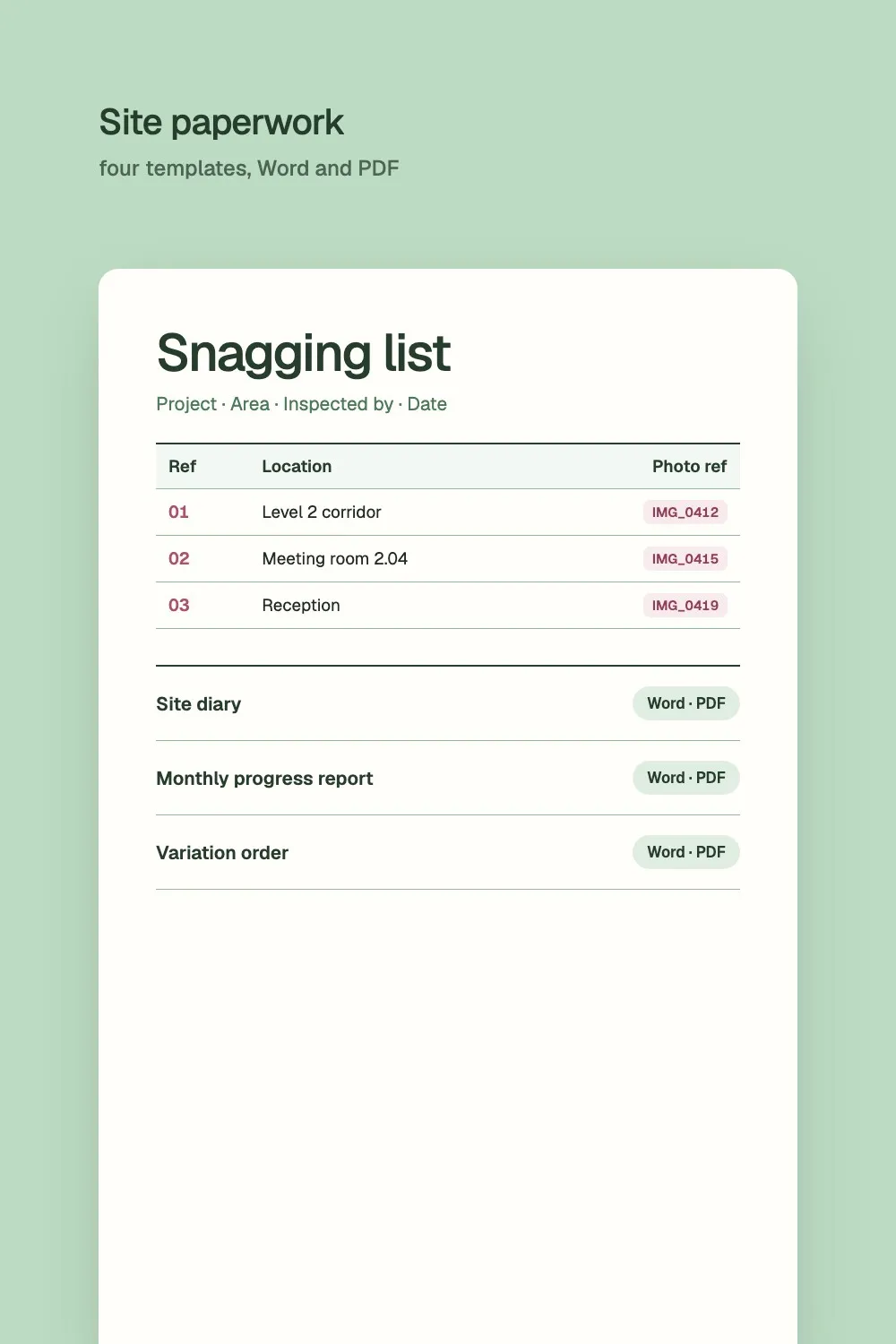
With a monthly progress report and variation order, in one download
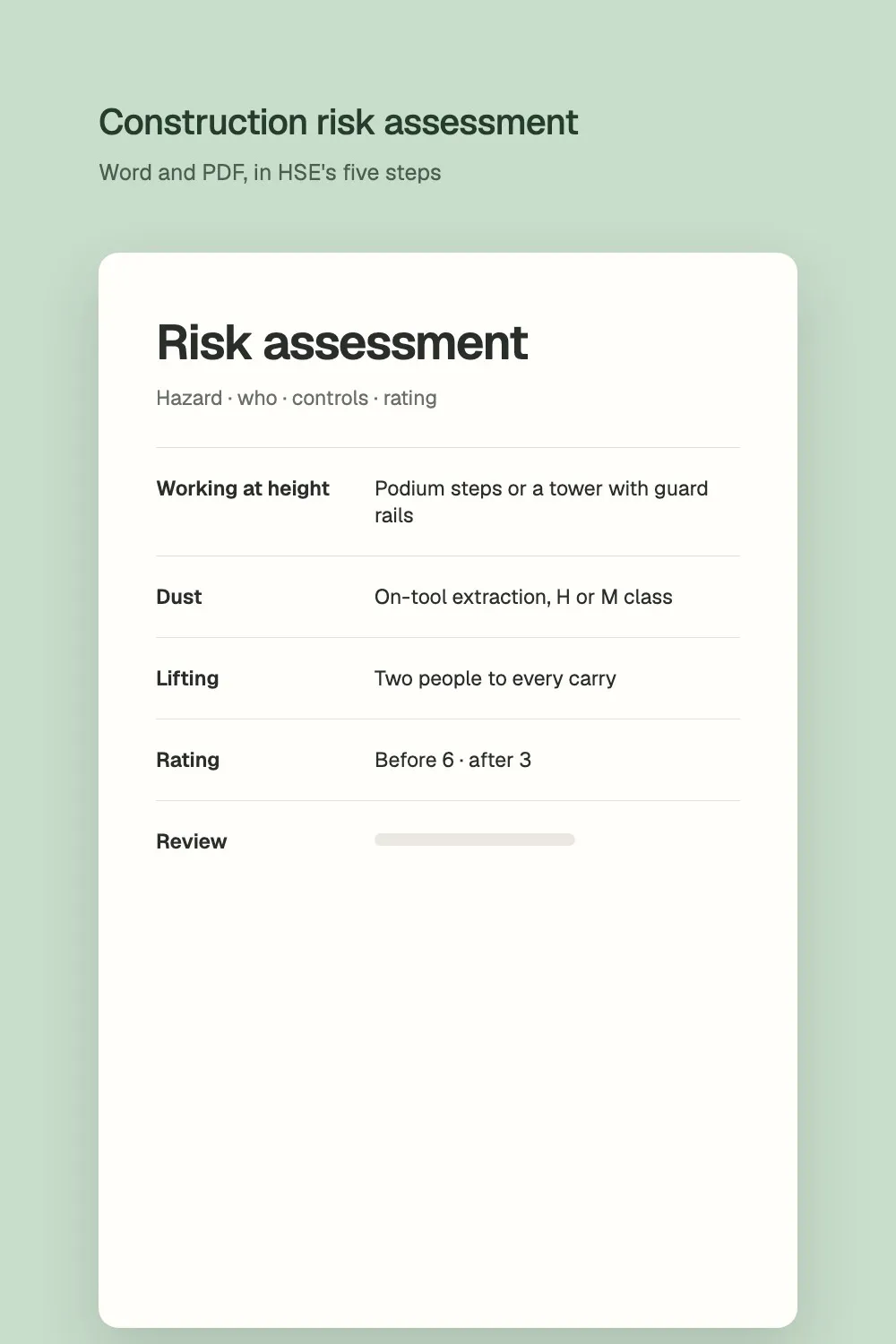
HSE's five steps, a risk rating and a review record